Back to PhysioFuturist

PhysioFuturist framework

The 10 Stages of Technological Displacement

From Denial to Nostalgia

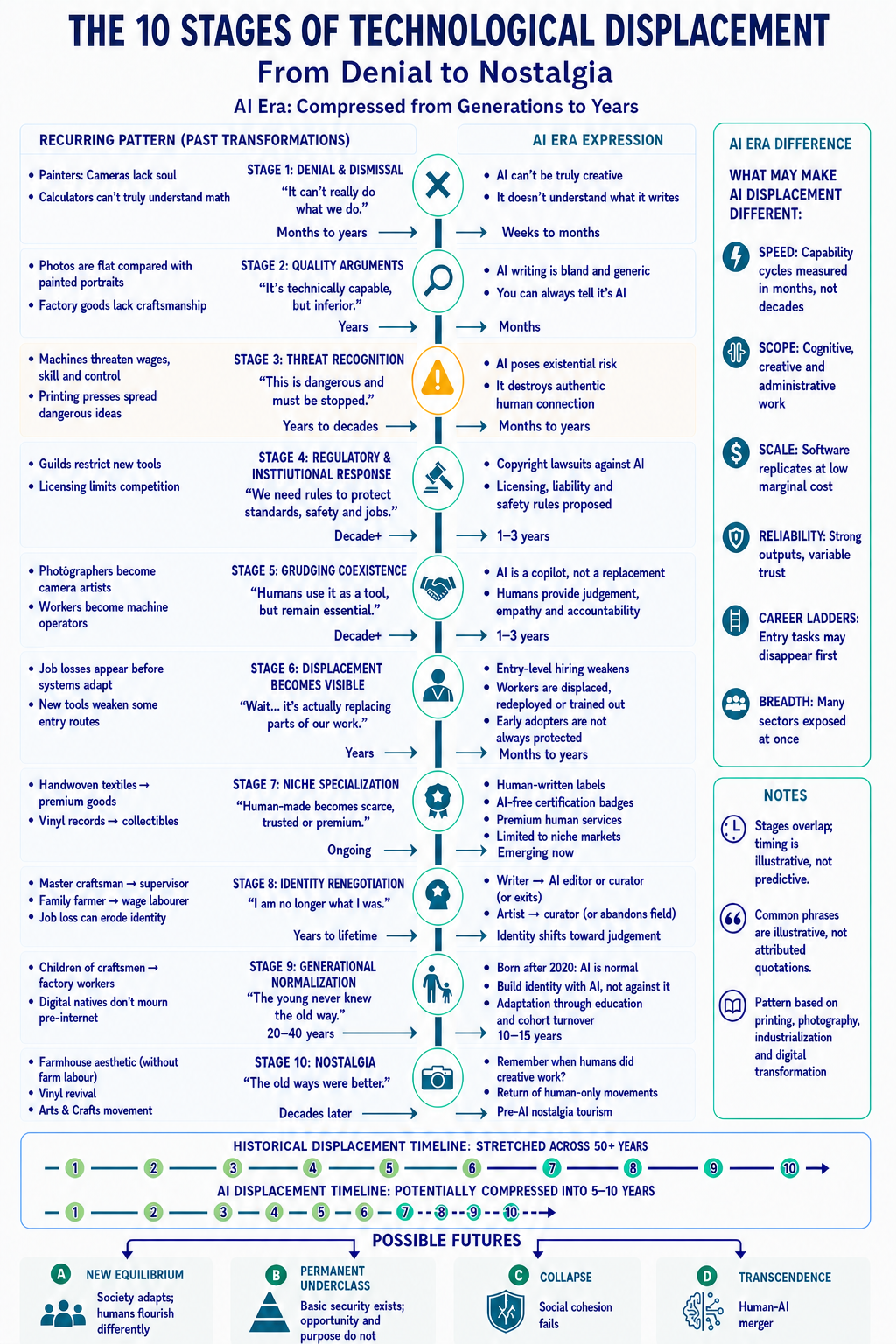
Technological transformations often produce recurring debates about quality, safety, work, identity, and human value. This framework compares those recurring patterns with the faster pressures of the AI era. Stages can overlap, repeat, and move at different speeds.

One-page framework

Explore the full model

Select the image to open a full-size version with browser zoom.

The 10 Stages of Technological Displacement, comparing recurring patterns from past transformations with AI-era expressions from denial through nostalgia
A conceptual framework by Jason Giesbrecht. Timing is illustrative, and stages may overlap.

How to read the framework

A recurring pattern under new pressure

Each stage pairs a recurring pattern from earlier technological transformations with a comparable AI-era expression. The timing labels show how a process that once unfolded over decades may be compressed into years or months.

Accessible text version

The ten stages

The quoted lines are illustrative common phrases, not attributed quotations. Stages can overlap, recur, or appear out of order.

Stage 1

Denial & Dismissal

“It can’t really do what we do.”

Recurring pattern

  • “Painters: Cameras lack soul.”
  • “Calculators can’t truly understand math.”

Historical timing Months to years

AI-era expression

  • “AI can’t be truly creative.”
  • “It doesn’t understand what it writes.”

AI-era timing Weeks to months

Stage 2

Quality Arguments

“It’s technically capable, but inferior.”

Recurring pattern

  • Photos are flat compared with painted portraits.
  • Factory goods lack craftsmanship.

Historical timing Years

AI-era expression

  • AI writing is bland and generic.
  • “You can always tell it’s AI.”

AI-era timing Months

Stage 3

Threat Recognition

“This is dangerous and must be stopped.”

Recurring pattern

  • Machines threaten wages, skill and control.
  • Printing presses spread dangerous ideas.

Historical timing Years to decades

AI-era expression

  • AI poses existential risk.
  • AI destroys authentic human connection.

AI-era timing Months to years

Stage 4

Regulatory & Institutional Response

“We need rules to protect standards, safety and jobs.”

Recurring pattern

  • Guilds restrict new tools.
  • Licensing limits competition.

Historical timing A decade or more

AI-era expression

  • Copyright lawsuits against AI.
  • Licensing, liability and safety rules proposed.

AI-era timing 1 to 3 years

Stage 5

Grudging Coexistence

“Humans use it as a tool, but remain essential.”

Recurring pattern

  • Photographers become camera artists.
  • Workers become machine operators.

Historical timing A decade or more

AI-era expression

  • “AI is a copilot, not a replacement.”
  • Humans provide judgement, empathy and accountability.

AI-era timing 1 to 3 years

Stage 6

Displacement Becomes Visible

“Wait… it’s actually replacing parts of our work.”

Recurring pattern

  • Job losses appear before systems adapt.
  • New tools weaken some entry routes.

Historical timing Years

AI-era expression

  • Entry-level hiring weakens.
  • Workers are displaced, redeployed or trained out.
  • Early adopters are not always protected.

AI-era timing Months to years

Stage 7

Niche Specialization

“Human-made becomes scarce, trusted or premium.”

Recurring pattern

  • Handwoven textiles become premium goods.
  • Vinyl records become collector items.

Historical timing Ongoing

AI-era expression

  • Human-written labels.
  • AI-free certification badges.
  • Premium human services.
  • Limited to niche markets.

AI-era timing Emerging now

Stage 8

Identity Renegotiation

“I am no longer what I was.”

Recurring pattern

  • Master craftsman becomes supervisor.
  • Family farmer becomes wage labourer.
  • Job loss can erode identity.

Historical timing Years to a lifetime

AI-era expression

  • Writer becomes AI editor or curator, or exits.
  • Artist becomes curator, or abandons the field.
  • Identity shifts toward judgement and responsibility.

AI-era timing Months to years

Stage 9

Generational Normalization

“The young never knew the old way.”

Recurring pattern

  • Children of craftsmen become factory workers.
  • Digital natives do not mourn pre-internet life.

Historical timing 20 to 40 years

AI-era expression

  • For those born after 2020, AI is normal.
  • They build identity with AI, not against it.
  • Adaptation comes through education and cohort turnover.

AI-era timing 10 to 15 years

Stage 10

Nostalgia

“The old ways were better.”

Recurring pattern

  • Farmhouse aesthetic without farm labour.
  • Vinyl revival and “vintage” everything.
  • The Arts and Crafts movement.

Historical timing Decades later

AI-era expression

  • “Remember when humans did creative work?”
  • A return of human-only movements.
  • Pre-AI nostalgia tourism.

AI-era timing Unknown

Beyond stage ten

Possible futures

The framework leaves the outcome open. Several social arrangements remain possible after displacement and adaptation.

A

New Equilibrium

Society adapts; humans flourish differently.

B

Permanent Underclass

Basic security exists; opportunity and purpose do not.

C

Collapse

Social cohesion fails.

D

Transcendence

Human-AI merger.

Model notes

Scope and interpretation

  • Stages overlap and their order may vary.
  • Timelines are illustrative rather than predictive.
  • Common phrases are illustrative, not attributed quotations.
  • The recurring pattern draws on printing, photography, industrialization and digital transformation.