
Publication details and suggested citation
Giesbrecht, J. (2026). How Physiotherapy Will Be Disrupted by AI (Not If). PhysioFuturist. https://physiofuturist.com/ai-white-paper
Published 24 August 2026.
ABOUT THE AUTHOR
Jason Giesbrecht is a Canadian physiotherapist, co-founder of PhysioFITT, and healthcare executive who serves as Executive Director of AI and Virtual Care in British Columbia, Canada. He teaches Leadership in Rehabilitation at the University of British Columbia and works internationally as a leadership development consultant and educator.
This paper is written from inside the profession it examines. Its purpose is not to predict the decline of physiotherapy but to help physiotherapists, clinic owners, educators, regulators, and payers examine a set of economic mechanisms before those mechanisms become visible in their financial statements and workforce data.
This paper applies the PhysioFuturist perspective of informed optimism and critical independence. It examines evidence, uncertainty, and real-world consequences, with human flourishing as the guiding purpose. Read the Perspective
EXECUTIVE SUMMARY
Artificial intelligence does not need to replace physiotherapists to disrupt physiotherapy. It only needs to make a meaningful portion of what physiotherapists currently provide sufficiently inexpensive, accessible, scalable, and effective that patients no longer require the same amount of professional time to achieve a successful rehabilitation outcome.
Physiotherapists have historically created professional value through three broad capabilities: specialized knowledge and judgment, specialized physical skill, and relational influence combined with accountable human presence. Around those capabilities sits a separate economic structure of limited entry to professional education, credentialing, licensure, regulation, professional liability, insurer recognition, and restricted professional supply. Those conditions create scarcity, and scarcity contributes to the economic value of physiotherapist time.
AI affects each source of value differently. Specialized rehabilitation knowledge is already becoming abundant and inexpensive, along with selected forms of routine reasoning, education, monitoring, progression, coaching, and behavioural support. Specialized physical skill is considerably more resistant, because physical examination, tactile assessment, needling, complex neurological handling, physical assistance, selected pelvic health procedures, and manual intervention continue to require human clinicians in the near term. The third capability is more exposed than many physiotherapists assume. Recent evidence indicates that AI-generated health communication is frequently rated as at least as empathic as clinician communication, and in many experimental settings more empathic. That evidence does not demonstrate that AI can reproduce a longitudinal therapeutic alliance, embodied presence, professional responsibility, or reciprocal trust during serious illness or disability. It does indicate that empathy, reassurance, motivational language, and conversational warmth should no longer be treated as uniquely human economic advantages. [1, 2, 3, 4]
The central mechanism is demand substitution rather than occupational replacement. It reduces how frequently patients need a physiotherapist and how much professional time each episode of care consumes.
The economic effect will also depend on who captures the resulting productivity gain. Lower labour requirements can become greater access or lower prices for patients, more manageable workloads or higher income for clinicians, stronger margins for clinic owners, lower claims costs for payers, or platform fees and market power for technology companies. Payment design, ownership, competition, and governance will determine how those benefits are distributed.
The Canadian numbers frame the exposure. Canada had 30,776 physiotherapists licensed to practise in 2024, including 21,683 in direct patient care, with direct-care supply increasing 4.9 percent between 2023 and 2024. [5] The Ontario Physiotherapy Association reported an average 60-minute private fee of approximately $148 in its 2026 market data. [6] The federal government cited approximately $700 as an industry average for annual eligible physiotherapy spending among comparable employer-sponsored plans when explaining its own $1,500 Public Service Health Care Plan benefit. [7] At contemporary private prices, that benefit finances a limited number of appointments, which means many patients already ration care.
The likely future is a continuum rather than a binary. AI autonomy will be greatest where complexity, risk, physical requirements, and uncertainty are low. Human involvement will rise as specialized physical skill, clinical uncertainty, and professional accountability rise. AI-supported relational communication may remain useful considerably further along that continuum than clinicians currently assume. And even where human involvement remains mandatory because of high risk or high complexity, AI will hold an important supporting and augmenting role. The clinician who learns to direct that support will deliver more efficient and more effective care than the clinician who does not.
The economic threat to traditional clinics is concentrated at the lower-complexity end. Clinic owners do not need to lose patients with stroke, spinal cord injury, severe trauma, or complex neurological conditions to experience disruption. If enough routine education, monitoring, progression, reassurance, and self-management support leaves the conventional visit model, even a modest reduction in volume can have a disproportionate effect on margins.
The direction of change is increasingly visible. Its magnitude and timing remain uncertain. Canada’s aging population, unmet rehabilitation demand, rising surgical volumes, patient preference for physical care, regulation, liability, and the persistent engagement problems of digital health transformation may slow substitution substantially. Those counterarguments are serious and are addressed directly in Part Seven.
The strategic response is not to defend every historical physiotherapy interaction. The stronger position is physiotherapist-governed AI rehabilitation, in which technology performs what it can safely and economically perform while physiotherapists concentrate their time where specialized physical skill, complex judgment, accountability, and human presence add the greatest value.
AI attacks scarcity by decreasing dependency on professional supply. That is the mechanism this paper asks physiotherapists and rehabilitation leaders to consider.
READER’S MAP
This paper has several intended audiences.
Physiotherapists may wish to focus on Part Three, which examines how the traditional sources of professional value are changing, and Part Eight, which considers what individual clinicians can do.
Clinic owners and operational leaders may find Parts Four and Six most relevant, since these examine the economics of substitution and possible new service models.
Educators and workforce planners may wish to focus on Parts Three, Seven, and Eight.
Regulators, professional associations, and insurers may find Parts Five, Seven, and Eight most useful, because their challenge is not whether AI exists but how safe, accountable, and measurable AI-supported rehabilitation should be governed.
PART ONE. THE MECHANISM.
1. FROM PROFESSIONAL REPLACEMENT TO DEMAND SUBSTITUTION
Much of the discussion about AI and the health professions begins with the wrong question. Asking whether AI can replace the professional produces immediately reassuring answers for physiotherapy. AI cannot currently palpate or manipulate a joint, physically assist someone following spinal cord injury, perform intramuscular stimulation, safely complete many pelvic health procedures, facilitate a complex neurological transfer, or physically protect a patient during difficult rehabilitation. Those observations are accurate, and yet they do not resolve the economic issue. A profession can experience major economic disruption long before technology reproduces the complete occupational role of the people working within it.
The more useful question is how much of the activity currently bundled inside a physiotherapy encounter can be provided without consuming the same amount of physiotherapist labour.
A patient with a relatively uncomplicated condition currently purchases several capabilities at once: assessment and interpretation, education and advice, exercise selection and progression, reassurance and motivation, monitoring, accountability, physical intervention, and professional responsibility. Historically all of those functions arrived through the same channel, which was an appointment with a physiotherapist. AI begins separating them. Some capabilities may remain predominantly human, some will be shared, and others may become inexpensive digital commodities.
Consider a patient who historically attended six physiotherapy appointments. In a future model, that individual might still require an expert physiotherapist for an initial assessment and one strategic reassessment, while education, routine questions, monitoring, exercise progression, adherence support, and symptom tracking occur asynchronously between those encounters. The physiotherapist has not been replaced. Four professional encounters may have been.
That is a fundamentally different economic mechanism from replacing an occupation, and it is the mechanism this paper examines.
2. THE ECONOMIC ARCHITECTURE OF SCARCITY
Scarcity is not a clinical capability of physiotherapists. It is a market condition surrounding the profession, and it should be analyzed separately from what physiotherapists actually do.
In Canada, the pathway into reimbursable physiotherapy runs in sequence from limited professional education capacity, to formal physiotherapy education, to demonstrated knowledge and competence, to credentialing and provincial registration, to professional liability and accountability, to protected title and regulated practice, to recognition by insurers, and finally to a restricted supply of reimbursable professionals.
This architecture exists for legitimate reasons. Physiotherapists make decisions and perform activities that can affect patient safety. Provincial regulators establish standards, protect titles, define professional obligations, and provide mechanisms for accountability. British Columbia, for example, restricts the titles physiotherapist and physical therapist to appropriately registered professionals. [8] Insurers benefit from these boundaries as well, since requiring services to be delivered by an eligible regulated physiotherapist gives payers a practical method of determining who has met defined educational, competency, accountability, and liability requirements.
Two forms of scarcity are useful to distinguish. Capability scarcity exists when safe care depends on genuinely scarce judgment, physical skill, experience, or accountability. Institutionally mediated scarcity arises from limited training capacity, credentials, protected titles, reimbursement rules, and other formal boundaries around access to professional work. Both can serve legitimate public purposes. AI affects them differently: it can make information and selected reasoning abundant while leaving the need for physical skill and accountable professional action largely intact.
The same structure produces an economic consequence. Professional supply is constrained, which creates scarcity, and scarcity contributes to bargaining power for physiotherapists while supporting the price clinics can charge for professional time.
Now consider what happens when technology changes demand rather than supply. Suppose a meaningful share of a clinic’s daily sessions are low-complexity visits requiring little or no hands-on intervention, and suppose AI enables those patients to obtain sufficient education, monitoring, progression, coaching, and recovery support without consuming the same, or any, physiotherapist time. Nothing about professional supply has changed. What has changed is how much professional labour the market requires. Section 9 works through the clinic-level arithmetic in detail, and the result is disproportionate: a modest decline in visit volume produces a much larger decline in operating profit.
The same logic scales from one clinic to a community, a province, and a national labour market. AI does not need to increase the supply of physiotherapists. It can weaken scarcity by reducing dependency on professional supply.
3. AI AS THE NEWEST ENTRANT IN AN EXISTING SUBSTITUTION TREND
AI is not the first challenge to the assumption that every rehabilitation need requires a physiotherapist. Patients already obtain overlapping components of recovery support from kinesiologists, athletic therapists, physiotherapist assistants, massage therapists, personal trainers, fitness services, internet resources, exercise applications, and self-management. These providers and services are not equivalent, and their education, regulation, scopes of practice, evidence bases, and risks differ considerably.
The economic point is narrower. Rehabilitation was already being unbundled before generative AI arrived, and physiotherapists and clinic owners have been adapting to that unbundling for years.
What makes AI unusual is its cost structure. The marginal cost of another explanation, another routine check-in, another reminder, or another educational interaction can be extremely low. Substitution by another human professional reproduces a labour cost structure. Substitution by technology does not. That difference is why AI is particularly consequential for the knowledge-intensive and communication-intensive portions of rehabilitation, and why the pattern of the past two decades is a poor guide to the next one.
PART TWO. THE TECHNOLOGIES.
4. AI IS NOT ONE THING
The term artificial intelligence combines several technologies that will influence rehabilitation in different ways and on different timelines. Treating them as a single force produces imprecise analysis.
Large language and multimodal models can communicate through text and voice, interpret images and other information, answer questions, synthesize clinical knowledge, support behaviour change, and participate in complex multimodal conversations. Their most immediate effect is on knowledge, communication, education, monitoring, and selected reasoning activities. These systems are probabilistic rather than deterministic, meaning that answers to the same question tend to vary and are not entirely predictable. That property makes them flexible and conversational, and it is also why Part Five argues that serious clinical applications require a governing layer of deterministic rules.
Computer vision can extract clinically relevant movement information from conventional cameras. Potential applications include range-of-motion estimation, repetition counting, exercise technique, functional monitoring, gait and movement analysis, and progression. This capability is no longer confined to specialized systems. Some consumer multimodal AI systems can already receive live camera input and respond conversationally to what they observe. Applying that capability to movement and exercise creates obvious rehabilitation possibilities, although consumer systems should not be confused with validated clinical assessment tools.
Wearable and ambient sensing can provide longitudinal information about activity, sleep, movement behaviour, exercise completion, training load, and recovery patterns. This shifts rehabilitation away from relying solely on what can be observed during intermittent appointments.
Predictive analytics can potentially identify which patients are progressing normally, which are deviating from expected recovery, and which require more intensive professional attention. The most important application may ultimately be allocation rather than prediction, meaning the question of where scarce human expertise should be directed.
Robotics belongs on a substantially longer timeline. Advanced AI combined with tactile sensing, computer vision, force measurement, dexterity, and reliable physical manipulation could eventually compete with selected physical capabilities of physiotherapists. Rapid advances in AI are reducing one important limitation in robotics: the ability to perceive, reason, adapt, and respond to complex environments. Major challenges in dexterity, tactile sensing, safety, reliability, cost, and clinical validation nevertheless remain.
Neurotechnology introduces a different pathway through which AI can affect physical rehabilitation. A 2026 meta-analysis of 16 randomized controlled trials involving 1,761 people after stroke found that brain-computer-interface rehabilitation was associated with moderate improvements in upper-limb motor function, functional activity, neurophysiological measures, and activities of daily living, with larger effects reported during subacute recovery. [25] The evidence remains limited by heterogeneous protocols and many small primary studies. A complementary review described how non-invasive EEG systems can decode motor intention and connect it with exoskeletons, functional electrical stimulation, or virtual reality to create closed-loop rehabilitation, while also identifying signal quality, individual variability, and BCI blindness as barriers to routine clinical use. [27] These systems show how AI, wearables, robotics, virtual reality, and neuromodulation may converge within a single rehabilitation intervention.
The central thesis of this paper does not depend on the arrival of sophisticated humanoid physiotherapy robots. If physiotherapy economics remain largely unchanged until such systems arrive, this paper’s main argument will have been wrong. The near-term thesis concerns the falling cost of rehabilitation intelligence, communication, monitoring, and routine support.
PART THREE. THE THREE SOURCES OF PROFESSIONAL VALUE UNDER PRESSURE.
5. SPECIALIZED KNOWLEDGE AND JUDGMENT
For much of the history of physiotherapy, access to specialized knowledge was an obvious source of professional value. Patients wanted answers to a predictable set of questions. What happened? Is this potentially serious? What activities should continue and what should stop? Which exercises are appropriate, and how quickly should they progress? What degree of pain is acceptable? When should further medical assessment occur? When can work or sport resume?
Physiotherapists added more than information. They interpreted uncertainty, recognized patterns, considered competing explanations, adapted treatment plans, and determined when recovery was not following the expected course.
AI attacks information scarcity directly. A capable conversational AI system can repeatedly explain rehabilitation principles, answer routine questions, discuss expected recovery, support exercise progression, reinforce pain education, summarize trends, provide activity guidance, and interpret patient-reported information. It can do so at any hour, without fatigue, and at negligible marginal cost. The price of specialized knowledge is heading toward zero.
The professional advantage can therefore no longer rest on the claim of knowing the correct rehabilitation information. That territory is becoming increasingly contestable.
Complex judgment remains more defensible, but the defence should not be overstated. A patient with unusual symptoms, multiple interacting conditions, significant risk, psychosocial complexity, or a recovery trajectory that does not make sense may require sophisticated professional reasoning combined with direct physical examination. Yet the boundary between routine reasoning and difficult judgment is a gradient rather than a wall, and routine reasoning is likely to become automated first. It is also worth being honest about the direction of travel. AI systems can synthesize large volumes of information and, when connected to appropriate evidence sources, incorporate current literature into their reasoning. Their ability to do so consistently and reliably in clinical settings remains an important limitation. But as frontier systems continue to advance, the assumption that complex clinical reasoning will remain durably human should be treated as provisional rather than settled.
A 2026 JAMA Perspective presses the argument further, proposing that autonomous AI may eventually outperform both physicians working alone and physicians aided by AI for selected cognitive tasks. The article is a reasoned forecast rather than a clinical trial, and much of the evidence it discusses comes from simulations or discrete tasks rather than longitudinal care. [29] Its importance lies in challenging the assumption that adding a clinician to an AI system will always produce the best result.
That challenge has empirical support beyond healthcare. A preregistered systematic review and meta-analysis of 106 experiments and 370 effect sizes found that human-AI combinations performed worse, on average, than the better standalone human or AI agent. Performance losses were concentrated in decision tasks, and combinations tended to lose ground when AI already outperformed humans working alone. The included studies were heterogeneous and were not specific to physiotherapy, so direct clinical inference would be premature. [30] The practical lesson is that human oversight should be designed and tested task by task; its benefit should not be assumed.
6. SPECIALIZED PHYSICAL SKILL
Specialized physical skill remains the strongest near-term source of distinctly human professional value.
Some rehabilitation requires another person to be physically present. Examples include complex examination, palpation, spinal manipulation, neurological handling, physical assistance, needling, selected pelvic health procedures, certain manual interventions, high-risk mobility training, and situations where tactile information materially changes clinical decisions. Regulation reinforces some of these boundaries. Ontario’s Controlled Acts Standard, effective August 1, 2026, sets requirements for physiotherapists performing activities such as spinal manipulation, pelvic internal examination, and acupuncture or dry needling. [9]
Where a skilled physical intervention is clinically indicated, access to an appropriately trained clinician is a matter of clinical need. A patient's willingness to pay for longer appointments, continuity with a preferred practitioner, or additional personal attention is a separate source of demand. Describing all future human care as a luxury would obscure that distinction. Selected pelvic health procedures and needling illustrate a present physical requirement; they do not establish that every service within those fields requires in-person delivery or will command a lasting price premium.
The protection is not necessarily permanent, since robotics could eventually place portions of physical rehabilitation into contestable territory. That is not the immediate economic issue.
Robotic systems may also extend physiotherapist capability rather than simply substitute for it. An interdisciplinary 2026 perspective on human-in-the-loop exoskeleton optimization argued that clinical expertise and human capacities should be incorporated into how these systems learn and adapt. [28] This points to a plausible professional role in defining therapeutic goals, setting safety boundaries, interpreting patient responses, and supervising adaptive physical technologies. The paper is conceptual rather than an outcomes study, so this role remains a design proposition rather than an established clinical effect.
The economics of software and physical automation also differ. Clinician time, attention, and geographic availability are finite. Software may support additional patients without a proportional increase in clinician hours, although validation, oversight, and service delivery still carry costs. Robotics adds equipment, maintenance, setup, and staffing requirements. In the RATULS trial's economic evaluation, robot-assisted upper-limb training added to usual care was more costly than usual care alone and was not cost-effective in the delivery model studied. [34] Lower-cost robotic care remains a possibility whose economics will depend on utilization, supervision, and outcomes.
The more immediate issue is volume. Even if advanced physical skills remain entirely human, the number of patients requiring high-intensity physical intervention may not be large enough to replace every lower-complexity professional encounter that technology makes unnecessary.
High-complexity care may preserve the necessity of physiotherapists without preserving the economics of every physiotherapy clinic. Those are separate propositions, and conflating them is one of the more common errors in professional discussions of AI.
7. RELATIONAL INFLUENCE AND ACCOUNTABLE HUMAN PRESENCE
The third source of value requires more careful treatment, because this is where many physiotherapists’ confidence is highest and the evidence is least reassuring.
Rehabilitation is relational. Patients may need reassurance, encouragement, accountability, confidence, motivation, help interpreting fear, support through setbacks, and assistance adapting to disability or a significant change in function. It has been tempting to treat this domain as a protected human advantage. Recent evidence makes that position increasingly difficult to hold.
A 2025 systematic review and meta-analysis identified 15 studies comparing AI chatbots with healthcare professionals on measures of empathy. Thirteen reported significantly higher empathy ratings for AI, with a pooled standardized mean difference of 0.87 favouring AI. The researchers appropriately noted that the evidence was predominantly text-based and frequently relied on proxy raters rather than longitudinal therapeutic relationships. [1]
Ruben and colleagues subsequently reported that participants rated ChatGPT-generated responses as more empathic than physician responses. Their results also showed an important source effect, since responses tended to be rated more favourably when people believed a physician had written them. [2]
Perceptions may also affect what patients say they would pay. In a preregistered 2026 study, 1,030 US participants evaluated fictional family-doctor advertisements. Physicians disclosing AI use were rated less favourably, and participants reported lower willingness to pay for their consultations. [35] The willingness-to-pay effect was small, and the study measured hypothetical choices in primary care rather than actual purchases, physiotherapy outcomes, or sustained therapeutic relationships. It supports examining the role of perceived human involvement without establishing a durable human-care premium or showing that AI-supported care is inherently less personal.
A 2026 systematic review and meta-analysis in the Journal of Medical Internet Research found that five of six direct comparisons favoured AI-generated communication for empathy, with a large pooled effect across four studies. The researchers also found no direct evidence establishing long-term trust, which is a significant limitation. [3]
The evidence is beginning to extend beyond simple text responses. A 2026 Nature Medicine study evaluated a multimodal conversational diagnostic AI against primary care physicians across 105 simulated telehealth consultations, and the AI performed similarly to or better than physicians across numerous dimensions of communication and clinical interaction. These were simulated encounters rather than real longitudinal therapeutic relationships, which limits the conclusion that should be drawn. [4]
Collectively, these findings narrow the human connection argument substantially. AI can increasingly reproduce functional aspects of relational care, including reassurance, validation, conversational empathy, motivational prompts, personalized explanations, behavioural support, and repeated supportive check-ins. Those are real components of rehabilitation, and physiotherapists currently charge for them.
They are not the entire therapeutic relationship, and the counter-evidence deserves equal weight.
A qualitative 2026 JAMA Network Open study found that patients were generally comfortable with AI-drafted portal messages but strongly valued clinician oversight and transparency, with many participants regarding portal messaging as a transactional rather than deeply relational component of care. [10] Another 2026 study found that participants provided symptom reports approximately 8 percent less suitable for initial medical urgency assessment when they believed they were communicating with an AI chatbot rather than a physician, indicating that the perceived identity of the listener changes the information people disclose. [11] A 2026 perspective in npj Digital Medicine cautioned against confusing linguistically convincing empathy with deeper relational meaning, describing a risk of empty empathy talk. [12]
The appropriate distinction is therefore between relational functions and accountable relationship. AI increasingly competes with the former. Far less is known about whether AI can reproduce a therapeutic alliance sustained over months of serious rehabilitation, physical presence during fear or disability, reciprocal trust under high stakes, professional responsibility, human advocacy, or the psychological meaning of another person physically helping someone regain function.
The third source of professional value is a spectrum of relational capabilities, some already technologically contestable and others still poorly tested. It should no longer be described as an impregnable human moat.
PART FOUR. THE ECONOMICS OF DISRUPTION.
8. THE CANADIAN PRIVATE-PRACTICE SETTING
Private physiotherapy clinics generally operate through a professional labour and fee-for-service model. A physiotherapist sees a patient, an encounter is billed, the clinician is compensated, the clinic pays its overhead, and whatever remains contributes to operating profit.
Inflation creates pressure on both sides of that equation. Clinic owners face higher rent, administration, insurance, technology, supplies, and facility costs, while physiotherapists face rising personal costs and seek higher compensation. Scarcity gives clinicians bargaining power in that negotiation. At the same time, patients and insurers face practical limits on what they are willing or able to pay.
The Ontario Physiotherapy Association reported an average fee of $148 for a 60-minute assessment or treatment in its 2026 Ontario market data, and those figures describe Ontario rather than Canada as a whole and vary by location and practice model. [6]
Extended health benefits reduce the immediate price experienced by many patients, but coverage is finite. The federal Public Service Health Care Plan provides a $1,500 annual physiotherapy maximum, reimbursed at 80 percent, and describes this as more than double the industry average of approximately $700. [7]
Public coverage adds little for most private-practice patients. For outpatient private-practice physiotherapy, direct MSP support in British Columbia is limited. Eligible British Columbians with Supplementary Benefits receive a $23 contribution per visit, within a combined annual maximum of 10 visits across several supplementary health services. [13]
At contemporary private prices, $700 represents a limited number of appointments. Patients therefore already make rationing decisions about whether another appointment is valuable enough to consume remaining benefits or require direct payment. AI inserts another option into a calculation patients are already performing.
9. WHY THE LOW-COMPLEXITY MARKET MATTERS
Suppose a clinic has a significant volume of relatively uncomplicated cases in which much of the professional activity involves education, reassurance, exercise prescription, progression, monitoring, pain education, and return-to-activity guidance. AI does not need to capture that entire caseload for the economics to change, because a sufficiently large reduction in repeat visits alters clinic profitability disproportionately.
The following example is deliberately illustrative rather than an industry benchmark.
| Annual measure | BASELINE | 10% VOLUME DECLINE | 20% VOLUME DECLINE | 30% VOLUME DECLINE |
|---|---|---|---|---|
| Annual revenue | $1,200,000 | $1,080,000 | $960,000 | $840,000 |
| Clinician compensation at 50% | $600,000 | $540,000 | $480,000 | $420,000 |
| Fixed and semi-fixed overhead | $420,000 | $420,000 | $420,000 | $420,000 |
| Operating profit | $180,000 | $120,000 | $60,000 | $0 |
| Operating margin | 15.0% | 11.1% | 6.3% | 0% |
Real clinics have more complicated cost structures. Some overhead can eventually be reduced, and some labour costs will not move perfectly with revenue. The example demonstrates sensitivity rather than prediction. In this scenario a 20 percent reduction in revenue reduces operating profit by two-thirds, and a 30 percent reduction eliminates it entirely.
The strategic question for a clinic owner is therefore not whether AI can treat the most complex patient in the practice. It is whether enough profitable routine volume can migrate elsewhere to destabilize the existing business model.
10. DIGITAL MUSCULOSKELETAL CARE IS ALREADY TESTING THE MODEL
The substitution model is no longer entirely theoretical. Digital musculoskeletal companies have developed employer- and payer-funded services combining exercise, education, behavioural support, digital monitoring, AI, and varying amounts of professional involvement.
A 2026 matched United States claims analysis compared participants in a digital musculoskeletal program with patients initiating conventional in-person physical therapy. The digital group was associated with approximately 2,026 US dollars lower annual musculoskeletal spending and 2,370 US dollars lower total healthcare spending per participant. The study was observational and several researchers were affiliated with the commercial provider, so causal claims require caution. [14]
A separate study examined what happened when AI-supported digital care allowed a roughly 2.3-fold increase in physiotherapist-to-patient ratios. Pain-response rates were similar between comparison groups while program completion was higher in the AI-supported model. That study was also commercially affiliated and requires independent replication. [15]
An independent 2024 assessment by the Peterson Health Technology Institute reached a more differentiated conclusion across virtual musculoskeletal care. It found that physiotherapist-guided virtual solutions can be effective alternatives to in-person physiotherapy and may reduce healthcare spending. App-based exercise therapy had a narrower role for lower-acuity patients at an appropriate price, while remote-therapeutic-monitoring programs added to in-person physiotherapy had high clinical efficacy but increased costs. [31] The category and payment model matter as much as the presence of technology.
These studies do not establish that digital rehabilitation is universally superior to in-person care, and their commercial sponsorship is a genuine limitation. What they demonstrate is the mechanism clinic owners should monitor, which is professional time per successful rehabilitation episode. If technology allows one physiotherapist to safely support significantly more patients without reducing outcomes, the economics of professional labour change even while physiotherapists remain part of the service.
A related shift deserves explicit attention here, because it compounds the substitution effect. A meaningful share of traditional repeat visits exists for monitoring and follow-up: the clinician needs to see how the patient is progressing, check exercise technique, and adjust the plan. Wearable sensors, camera-based movement analysis, and continuous conversational AI now allow much of that monitoring to happen between visits rather than through them. When a patient’s activity data, symptom reports, and exercise completion arrive continuously, and when the patient can ask a question or demonstrate a movement over live video at any time, the clinical rationale for booking a return visit purely to check on progress weakens rapidly. The follow-up appointment, long a dependable component of clinic volume, is among the most exposed categories of professional encounter.
11. THE SECOND-ORDER LABOUR EFFECT
Consider a community where conventional patient demand supports 15 physiotherapists. Clinics compete to recruit clinicians, wait lists exist, and physiotherapists can negotiate relatively strong compensation because professional labour is scarce.
Now imagine technology reduces the traditional professional time required for uncomplicated rehabilitation. The earliest result may simply be improved access, with shorter wait times, easier vacancy filling, and faster appointments for patients. That is a good outcome, and it may persist for years.
If substitution grows far enough, bargaining dynamics could eventually shift. Clinicians may begin competing more intensely for patients or positions, underemployed physiotherapists may establish low-overhead practices, new clinics may charge less than established competitors, and price competition could increase.
The result does not need to be widespread unemployment. It may appear instead through shorter wait lists, fewer vacancies, slower real wage growth, greater clinician availability, more independent clinics, lower or more variable fees, and tighter clinic margins.
Canada begins from a strong demand environment, so these effects could take years to emerge and may be highly uneven across regions and practice types. The narrower and more testable hypothesis is that AI could progressively reduce the scarcity premium attached to portions of generalist physiotherapy work.
Will specialist human care retain its premium?
Human-delivered care may retain a price premium where patients require skilled physical intervention or value sustained personal attention. However, that premium depends partly on how many clinicians can provide the service relative to the demand that patients and payers can fund. As AI reduces the clinician time required for some routine encounters, physiotherapists may increasingly pursue the same specialist capabilities. If that additional capacity grows faster than funded demand, competition could put pressure on fees, appointment volumes, and earnings.
This creates a potential tension between individual adaptation and profession-wide outcomes. Additional training may strengthen one clinician's position while offering less economic protection when widely adopted. A service can remain clinically valuable and substantially human-delivered even as its financial premium narrows. Human care could also remain more expensive than digital alternatives while generating less income for its providers. Whether this occurs will depend on unmet need, referral patterns, reimbursement, local workforce supply, and demonstrable differences in outcomes. Specialist training alone cannot guarantee sustained pricing power.
Payment arrangements shape how competition reaches providers. A Finnish study of rehabilitation procurement found that a reform changing provider selection and bidding rules slowed price growth, with stronger effects in more competitive local physiotherapy markets. [36] That finding concerns publicly purchased rehabilitation, rather than AI-driven specialist retraining or Canadian private clinics. It supports treating pricing power as dependent on market and purchasing conditions. In markets with substantial unmet funded demand, additional specialist capacity could improve access for years. Where that capacity exceeds funded demand, pressure might first appear as unfilled appointments or slower real earnings growth, even while posted fees remain unchanged.
Who captures the productivity gain?
Time saved by AI does not automatically become more patient care. It may be absorbed by other administrative work, retained as additional margin, passed to payers through lower claims, shared with clinicians through better compensation or workload, passed to patients through lower prices or greater access, or captured by the technology platform through fees. A national Canadian example illustrates the distinction: Canada Health Infoway reports that its AI Scribe Program enrolled more than 12,000 primary care clinicians, yet only 20 percent of participants redirected saved time toward increased appointment availability. [32] The program concerns primary care documentation rather than physiotherapy, but it shows why productivity and access should be measured separately.
12. THE INSURANCE PARADOX
Insurers may adapt more slowly than consumers, and that lag creates an unusual dynamic.
Traditional insurance works efficiently with regulated fee-for-service care. A licensed physiotherapist provides a recognizable service, a receipt is generated, the insurer verifies eligibility, and reimbursement occurs according to the policy. AI-supported rehabilitation creates more difficult questions. Who is the provider? What exactly constitutes the service? Who carries clinical responsibility? Is the product general wellness support, treatment, or a medical device? Should payment be monthly, episodic, or tied to professional encounters?
The earliest consumer market may therefore grow partly outside traditional insurance. A patient considering a $150 appointment asks whether insurance will pay for it. A patient considering a low-cost digital recovery service may simply ask whether it is worth paying for personally. When the absolute price falls far enough, the insurer loses some of its power as gatekeeper to rehabilitation access.
Low price does not exempt a service from regulation, and this is where the direct-to-consumer lane becomes complicated. A platform is more likely to remain outside some forms of medical-device or professional-practice regulation when its claims remain wellness-adjacent. The more clearly it claims to diagnose, treat, or autonomously manage a medical condition, the more relevant formal oversight becomes. That boundary will itself become contested terrain, and organizations will have commercial incentives to position themselves on the permissive side of it.
Insurers could eventually move in the opposite direction. If physiotherapist-governed hybrid programs consistently achieve comparable or better outcomes with lower total claims costs, insurers will have an economic reason to fund them. A technology that initially threatens conventional fee-for-service physiotherapy may later appeal to insurers for precisely the same reason it threatens clinics, because it reduces the quantity of expensive professional labour purchased per recovery episode.
These pressures are likely to be strongest in routine outpatient musculoskeletal care, where pathways are relatively standardized and digital alternatives are already being purchased at scale. A platform that becomes the payer's preferred front door can influence which patients reach a clinic, what professional input is purchased, and which organization retains the economic benefit. This does not describe all physiotherapy, particularly complex neurological, postoperative, high-risk, and physically dependent care.
PART FIVE. REGULATION, LIABILITY, AND TRUST.
13. REGULATION MAY SLOW DISRUPTION WITHOUT PREVENTING IT
An AI health service cannot avoid regulation merely by changing its name. Function and intended purpose matter more than branding.
Health Canada’s 2026 guidance confirms that machine-learning software used to achieve an intended medical purpose can fall within Canada’s medical-device framework, and the guidance addresses risk management, data quality, testing, clinical validation, transparency, and post-market monitoring. [16] Professional regulation adds another layer, since protected titles cannot simply be adopted by unregulated organizations and controlled professional activities remain governed by provincial rules. Privacy adds further obligations, with Alberta, British Columbia, and Quebec maintaining private-sector privacy statutes recognized as substantially similar to PIPEDA, and several provinces holding additional health-information legislation applicable to custodians. [17]
These protections matter. They do not necessarily protect the volume of traditional physiotherapy visits.
Regulators can protect professional titles, controlled activities, standards, privacy, and accountability. They cannot require a consumer to purchase a professional appointment in order to receive general education, reminders, motivation, low-risk exercise information, symptom journaling, or general self-management support.
The relevant economic question is therefore not whether AI can legally call itself a physiotherapist. It is how much of the value historically sold inside physiotherapy appointments can be delivered without reproducing the regulated professional transaction.
14. LIABILITY MAY SHAPE THE WINNING MODEL
Consider a person with low back pain using an AI recovery application who reports symptoms that should trigger urgent assessment for a serious neurological condition. The system provides reassurance instead. Who is responsible?
The answer will depend on the nature of the product, the claims made to users, applicable medical-device requirements, professional involvement, contracts, jurisdiction, and the circumstances of the failure. There is currently no settled answer, and that uncertainty is a significant brake on fully autonomous clinical AI.
Liability uncertainty also creates an opportunity for clinic owners and clinical leaders. A professionally governed system can define inclusion criteria, exclusions, red flags, mandatory human reviews, escalation thresholds, documentation standards, audit trails, and accountable clinical leadership. That produces something a generic consumer chatbot may not offer, which is a defined safety architecture backed by an identifiable accountable party.
Liability may therefore determine less whether AI enters rehabilitation and more which organizational models become trustworthy enough to scale. Physiotherapists are unusually well positioned to supply the missing element, since accountability is already part of what their registration means.
15. GOVERNED AI RATHER THAN PURELY PROBABILISTIC CARE
A serious rehabilitation platform should not depend on a general-purpose language model improvising every clinical decision. A stronger architecture combines deterministic clinical rules with probabilistic conversational intelligence.
The deterministic layer specifies eligibility, postoperative restrictions, contraindications, red flags, escalation criteria, progression limits, and required professional review. These are the decisions that should not vary between two identical patients on two different days.
The probabilistic layer provides explanation, personalization, conversation, encouragement, question answering, progress summaries, education, and behavioural support. These are the interactions that benefit from flexibility and adaptation.
This architecture preserves the strengths of modern AI while recognizing that clinical safety sometimes requires explicit boundaries. It also changes where defensible value sits. A clinic’s important intellectual asset may not be its AI model, since foundational models will be built by organizations with resources no clinic can match. The asset is the clinically governed system surrounding the model, meaning the pathways, rules, escalation logic, outcome measurement, accountability, and integration with in-person care.
Evidence-grounded retrieval offers another layer of governance. In a 2026 study from occupational therapy, researchers organized 3,023 case reports into a knowledge graph linking assessment findings, goals, and intervention plans. The graph retrieval-augmented system produced AI-generated plans with greater faithfulness to the retrieved cases than keyword, embedding, random-reference, or ungrounded approaches. [26] The study assessed source grounding, not clinical correctness or patient outcomes, and its findings should not be treated as direct evidence for physiotherapy. It nevertheless illustrates a credible route from general-purpose generation toward traceable rehabilitation decision support in which clinicians can inspect the evidence behind a suggestion.
Governance should describe system boundaries, evidence standards, monitoring, escalation, auditing, and accountability. It does not require a physiotherapist to approve every low-risk action. A practical autonomy ladder can move from clinician-led care, to AI-supported care, to AI-led care with exception review, and finally to validated autonomous care for narrowly defined low-risk tasks. Progression along that ladder should depend on comparative outcomes, failure detection, and clear responsibility rather than professional preference alone.
PART SIX. THE FUTURE REHABILITATION MODEL.
16. DISENTANGLING THE REHABILITATION POPULATION
The traditional organizing question is profession-centric. Does this patient need physiotherapy? A better future question is capability-centric. What does this patient require right now?
Consider a hypothetical population of 1,000 people seeking rehabilitation support. Some may have stroke, spinal cord injury, traumatic brain injury, amputation, severe trauma, or complex neurological disease. Others may be recovering from ACL reconstruction, joint replacement, fractures, tendon injury, or surgery. Others may have uncomplicated ankle sprains, running injuries, mechanical back pain, mild knee pain, or gradual-onset shoulder symptoms. Some may primarily require education, monitoring, reassurance, exercise progression, pain education, or return-to-activity advice.
These people should not automatically receive the same professional container. Physiotherapists and service designers could instead stratify rehabilitation need according to clinical complexity and risk, need for physical examination or tactile intervention, predictability of recovery, ability to self-manage, psychosocial and relational complexity, and need for regulated professional accountability.
Diagnosis remains important. It simply stops being the only organizing principle.
17. FIGURE 1. THE AI-HUMAN REHABILITATION CONTINUUM
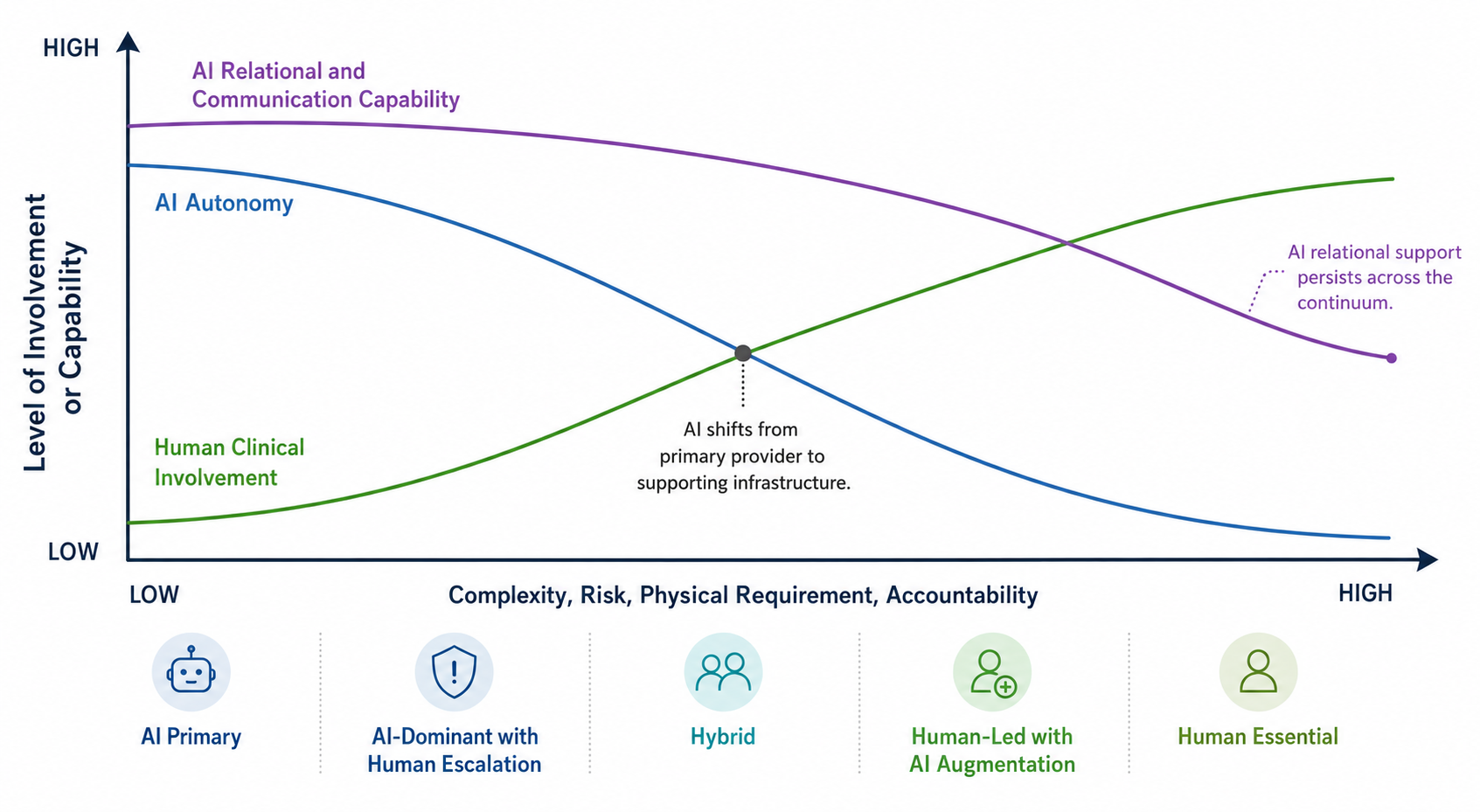
Figure 1. The AI-Human Rehabilitation Continuum. Three curves plotted across a horizontal axis running from low to high complexity, risk, physical requirement, and accountability. AI autonomy begins high and declines steadily. Human clinical involvement begins low and rises steadily, crossing the AI-autonomy curve near the middle, where AI shifts from primary provider to supporting infrastructure. AI relational and communication capability begins high and stays high across most of the continuum, declining only gently toward the high-complexity end. Five zones run left to right beneath the axis: AI Primary, AI-Dominant with Human Escalation, Hybrid, Human-Led with AI Augmentation, and Human Essential.
The AI-autonomy curve begins high at the low-complexity end and declines as uncertainty, risk, physical requirements, and professional accountability increase. Human clinical involvement moves in the opposite direction, beginning minimal and rising steadily.
The third curve reflects the most important revision to the original model. AI-supported relational communication remains high much further along the complexity continuum than either of the other two curves would suggest. AI may continue to provide reassurance, validation, education, motivation, and conversational support even when a human physiotherapist has become necessary for entirely different reasons. The relational curve does not track the autonomy curve, and assuming it does is the error this paper is most concerned to correct.
The human advantage therefore concentrates less around being empathic and more around embodied presence, difficult judgment, physical intervention, professional responsibility, advocacy, and trust when the stakes are high.
18. MULTIPLE CARE LANES
The continuum produces several possible models rather than a binary split between digital and human rehabilitation.
In AI-dominant recovery, AI provides education, guidance, monitoring, progression, and conversational support, while the physiotherapist handles escalation when required.
In AI-supported self-management, AI provides ongoing support and tracking, while the physiotherapist performs the initial assessment or defined checkpoints.
Under periodic professional oversight, AI handles routine interactions and longitudinal monitoring, while the physiotherapist provides strategic review and course correction.
In hybrid rehabilitation, care is shared between AI and clinician throughout.
In human-dominant rehabilitation, AI handles documentation, education, analytics, and monitoring, while the physiotherapist performs assessment, treatment, judgment, and progression.
In high-complexity human care, AI provides background support and decision assistance, while the physiotherapist delivers central care, physical intervention, and accountability.
Patients could move between these lanes during a single episode. A patient following surgery might initially require substantial physiotherapist involvement, transition to AI-supported self-management during a predictable middle phase, and return to more intensive professional care if recovery stalls. The service becomes responsive to changing need rather than fixed around the appointment.
19. CLINIC OWNERS MAY SELL RECOVERY RATHER THAN VISITS
The traditional private clinic sells appointments. Clinic owners could instead begin building recovery pathways.
An eight-week knee recovery pathway might include an initial physiotherapist assessment, a governed rehabilitation plan, AI-supported education, asynchronous communication, symptom monitoring, standardized outcome measurement, progression rules, defined clinician checkpoints, and rapid escalation. One patient might require two professional encounters and another might require six. The product is the recovery process rather than a predetermined quantity of physiotherapist time.
That change alters incentives in a way worth stating plainly. Under conventional fee-for-service economics, reducing unnecessary visits reduces revenue, which is why the current model contains no reward for efficiency. Under an episode or pathway model, achieving an excellent outcome with fewer professional minutes becomes evidence of better value and a competitive advantage.
Clinic owners may therefore compete by offering a continuum that includes low-cost digital recovery support, AI-supported asynchronous care, virtual professional care, hybrid rehabilitation, conventional in-person treatment, and premium specialist services. That is a more flexible position than assuming every patient should progress through repeated in-person visits.
One structural obstacle deserves honest acknowledgment. Treatment models in private rehabilitation are often driven by payers rather than by clinics. Automobile insurers, workers’ compensation boards, and extended health plans frequently prescribe the service model as a condition of payment, and clinics adopt those models not because they are the most effective or most logical but because compliance is required to be paid. Unless payers modernize their prescribed models, clinics may find themselves unable to modernize care delivery even when they want to. This creates a specific and underappreciated risk: if technological capability advances faster than payer frameworks, the gap between what rehabilitation could be and what reimbursed rehabilitation is allowed to be will widen, and the direct-to-consumer market described in Section 12 will grow in that gap. Payer engagement is therefore not an afterthought to the strategy in this section. It is a precondition for it.
20. OUTCOMES AND THE FRONT DOOR
Technology could also change how clinics compete. Private clinics currently differentiate through location, reputation, convenience, availability, clinician credentials, particular treatment approaches, customer experience, and price. A more mature market could compare functional outcomes, return-to-work times, return-to-sport times, recurrence, adherence, number of professional encounters, patient experience, and total cost of recovery.
The value proposition could shift from offering 45-minute appointments to demonstrating that patients with a given recovery profile achieve defined outcomes at a defined total cost with a defined amount of professional involvement. The competitive unit becomes the recovery episode rather than the encounter.
A second strategic issue may be even more consequential, and it concerns who owns the first rehabilitation interaction.
A patient who twists an ankle historically searched for a physiotherapy clinic. Increasingly, that person may open a general-purpose AI system and describe the injury. If the AI asks questions, provides education, gives initial guidance, monitors symptoms, offers exercise, provides encouragement, and determines when professional escalation is needed, the technology platform effectively owns the beginning of the rehabilitation relationship. The physiotherapy clinic becomes a downstream provider receiving only the cases the platform routes onward.
Clinic owners have another option, which is to develop trusted digital front doors themselves while using general AI infrastructure inside clinically governed systems. Who owns the first rehabilitation interaction may ultimately matter as much as who provides the first physical treatment.
PART SEVEN. OBJECTIONS, TIMING, AND EVIDENCE.
21. THE STRONGEST COUNTERARGUMENTS
A credible paper should state clearly what could weaken its thesis. Each objection below is followed by the response this paper offers and, where relevant, the measurement that would settle it.
Induced demand. AI may expand rehabilitation access rather than replace professional care. Canada has substantial unmet need, and an inexpensive accessible service may primarily reach people who currently receive no rehabilitation at all. If that occurs, the digital market could grow substantially while clinic volumes remain healthy. This may well be the dominant early effect. The proper test is not digital adoption alone but professional encounters and professional minutes per comparable episode. If those measures do not fall as digital adoption rises, the substitution argument is weakened.
Current workforce shortages. Many clinic owners currently struggle to recruit physiotherapists. Reduced scarcity may initially appear as normalized access rather than underemployment, with wait times declining and vacancies becoming easier to fill long before clinicians experience labour-market pressure. The indicators to watch are vacancies, recruitment time, wait lists, compensation, and professional hours per episode.
Demographics and growing demand. Canada’s aging population will increase many forms of health and rehabilitation demand. Statistics Canada estimated that people aged 65 and older represented 19.5 percent of the population in 2025 and projects that this share will continue increasing under all major scenarios. [18] Surgical demand is also substantial, with CIHI reporting 175,242 hip and knee replacements in 2024 to 2025, a 26.5 percent increase from 2019 to 2020. [19] These trends may offset technological substitution for years. The important distinction is between employment and labour intensity, because Canada could employ more physiotherapists in the future while each patient requires fewer physiotherapist minutes.
Patients value touch. People do not make healthcare choices solely on efficiency. Some patients value physical contact, personal attention, manual intervention, and the experience of in-person care even when a less expensive alternative may produce comparable functional outcomes. Those preferences could sustain a premium human-care market, whose size and pricing power remain uncertain. Clinically necessary physical care represents a separate need, and service design should preserve access according to clinical need rather than ability to purchase additional attention. As discussed in Section 11, the economic question also depends on how quickly specialist supply grows relative to funded demand. Human involvement alone cannot establish that every existing clinic will retain its volume or margins.
Digital health has an adherence problem. Earlier digital rehabilitation technologies frequently struggled with engagement. A 2021 systematic review found no convincing overall improvement in therapeutic-exercise adherence from the digital interventions studied. [20] A 2022 meta-analysis found improved adherence at intermediate follow-up but not a meaningful long-term advantage. [21] Conversational AI may improve engagement because it can respond, personalize, encourage, explain, and adapt, and the empathy evidence gives that hypothesis greater plausibility. It does not prove it. If patients abandon AI rehabilitation at rates similar to earlier exercise applications, the disruptive effect will be substantially smaller.
COVID did not make rehabilitation permanently virtual. The pandemic provided an unplanned experiment in virtual care. Canadian physiotherapists rapidly expanded virtual services, but much physiotherapy subsequently returned to in-person delivery. Ezzat and colleagues documented extensive virtual-care adoption among Canadian physiotherapists during the pandemic and identified both accessibility benefits and important limitations, including difficulty delivering hands-on care. [22] This should caution against simplistic technological predictions. However, conventional virtual physiotherapy preserved the labour model, since a 45-minute video appointment still required approximately 45 minutes of a physiotherapist’s time. Telehealth changed where physiotherapists worked. Generative AI could change how much physiotherapist time is required at all.
The radiology warning. Healthcare has experienced confident AI replacement predictions before. Geoffrey Hinton predicted in 2016 that deep learning would soon outperform radiologists and suggested that training radiologists could become unnecessary. Radiologist demand subsequently grew, and later analyses documented why those short-term replacement predictions underestimated the complexity of the occupation. [23] Physiotherapists should learn from that history, and so should this paper. The argument here is not occupational replacement. The mechanism is task unbundling, productivity change, and demand substitution, which makes the hypothesis both narrower and more testable than the prediction Hinton made.
Autonomous AI may outperform human-AI care. The JAMA Perspective argues that adding a professional can introduce anchoring, automation bias, inconsistency, and coordination costs, while the broader meta-analysis found that combined systems often failed to beat the stronger standalone agent. [29, 30] This is a serious counterargument to a reflexive hybrid-care model. Current evidence remains dominated by simulations, bounded tasks, and non-physiotherapy settings. Rehabilitation also includes physical examination, hands-on intervention, longitudinal communication, values, and accountability. The question should be settled through direct comparisons of AI alone, physiotherapists alone, and combined systems for defined patient groups and tasks.
Equity and the digital divide. AI could improve access for people without extended benefits, patients in geographically underserved areas, people unable to take time away from work, and those needing assistance outside conventional clinic hours. Technology will also serve some people poorly, with barriers including low digital literacy, unreliable connectivity, sensory or cognitive impairments, language barriers, complex disability, distrust of AI, and a straightforward preference for human care. The appropriate future is therefore unlikely to be digital-only rehabilitation. Physiotherapists and service leaders should design multiple routes into care so patients can receive inexpensive technology when it works and accessible human support when it does not. This is also a durable role for human clinicians that has nothing to do with clinical complexity.
22. TIME HORIZONS
These horizons are judgments offered for testing rather than claims of certainty.
From 2026 to 2029, the most visible effects are likely to involve documentation, patient communication, consumer injury questions, AI-supported education, exercise support, outcome monitoring, administrative automation, and early asynchronous-care models. This is primarily the knowledge and workflow phase, and its effects on clinic revenue may be modest.
From 2029 to 2034, if evidence, consumer acceptance, regulatory frameworks, and payment models mature, physiotherapists and clinic owners may see more substantial hybrid rehabilitation, bundled recovery pathways, reductions in professional minutes per episode, AI-first services for selected uncomplicated conditions, insurer pilots, and greater competition for routine musculoskeletal patients. This is the period in which the business-model hypothesis should become clearly measurable, and it is the period this paper is principally about.
This middle horizon is not speculative. It has already begun in at least one publicly funded system. In the United Kingdom, Flok Health holds medical-device certification under MHRA regulations and Care Quality Commission registration for a digital service that automates the triage, assessment, and treatment of low back pain, with escalation to human clinicians when required. Cambridgeshire Community Services NHS Trust deployed the service at scale in February 2025. Over the 12-week pilot, more than 2,500 patients accessed the AI clinic, fewer than 2 percent requested or required referral to face-to-face care, and 80 percent rated the experience as equivalent to or better than traditional physiotherapy. The AI clinic reduced the back-pain waiting list by 55 percent and saved a reported 856 clinician hours per month, within a broader program that cut overall musculoskeletal waiting times by 44 percent. The Trust subsequently commissioned the service to manage eligible low-back-pain and sciatica patients as an end-to-end digital pathway in place of the traditional one, and the service expanded into additional NHS regions in early 2026. [24]
One service, one condition, one health system: but it is a working example of the AI-first, physiotherapist-governed lane this paper describes, operating inside a public payer, years ahead of the timeline many clinicians assume.
Beyond 2034, advanced physical robotics may begin competing for selected tactile and physical activities. This is the most speculative horizon and is not necessary for the central thesis.
23. THE RESEARCH AGENDA
The central propositions of this paper should be tested rather than accepted on assertion. Thirteen hypotheses follow, each with its observable indicators and the evidence that would weaken it.
First, that AI substitutes for some uncomplicated professional visits. Measure visits per musculoskeletal episode, claims data, and digital-program use. The hypothesis weakens if digital adoption rises without a reduction in comparable professional encounters.
Second, that AI reduces human time per recovery. Measure physiotherapist minutes per episode and clinician-to-patient ratios. It weakens if human labour remains unchanged despite AI adoption.
Third, that AI performs meaningful relational functions. Measure empathy, alliance, trust, adherence, and satisfaction. It weakens if longitudinal AI-supported relationships perform materially worse.
Fourth, that effective physiotherapist scarcity decreases in exposed markets. Measure vacancies, recruitment time, compensation trends, and wait times. It weakens if labour shortages worsen despite substantial digital substitution.
Fifth, that hybrid care becomes common. Measure the percentage of clinics offering asynchronous or hybrid pathways. It weakens if visit-only care remains dominant.
Sixth, that insurers adopt AI-supported rehabilitation. Measure new benefit categories, bundled payment models, and digital musculoskeletal contracts. It weakens if payers reject well-evidenced lower-cost models.
Seventh, that outcomes replace encounter volume as a competitive measure. Measure patient-reported outcome collection, episode-cost reporting, and outcome contracts. It weakens if competition remains dominated by visit price and location.
Eighth, that AI expands access. Measure previously untreated users, rural uptake, and uninsured users. It weakens if digital services mainly substitute for existing privately funded care.
Ninth, that specialist physical services face weaker pricing power where qualified capacity grows faster than funded demand. Track specialist workforce growth, referral volumes, funding, appointment fill rates, wait times, inflation-adjusted fees, and net earnings per clinical hour. Compare local markets and account for case mix, outcomes, and changes in reimbursement. The hypothesis weakens if pricing power and real earnings remain stable or strengthen despite sustained growth in competing capacity relative to funded demand. Growing clinical need alone cannot establish how much care patients and payers will purchase.
Tenth, that conversational AI improves engagement. Measure completion, adherence, and longitudinal outcomes. It weakens if AI abandonment resembles earlier application abandonment.
Eleventh, that the best care configuration varies by task. Compare AI alone, physiotherapists alone, and combined systems for defined patient groups using clinical outcomes, adverse events, escalation, cost, and professional minutes. It weakens if one configuration consistently dominates across low-risk rehabilitation tasks.
Twelfth, that the distribution of productivity gains is a separate outcome. Measure access, prices, clinician workload and compensation, clinic margins, payer spending, and platform fees. It weakens if savings are consistently shared across these groups without meaningful trade-offs.
Thirteenth, that poorly timed AI use can weaken independent clinical competence. Measure unaided reasoning and performance before and after sustained AI-supported training, including error detection and transfer to unfamiliar cases. It weakens if structured AI use preserves or improves independent competence over time. [33]
Professional associations, academic researchers, insurers, clinic networks, and regulators should begin collecting these measures now, because retrospective analysis will be considerably harder than prospective tracking.
The value of this paper should not depend on whether critics agree with its predictions. It should depend partly on whether it identifies the right questions to measure.
PART EIGHT. WHAT PHYSIOTHERAPISTS AND LEADERS SHOULD DO.
24. PHYSIOTHERAPISTS
Individual physiotherapists should stop asking only whether AI will replace them. The more useful question is which parts of their work genuinely require human intervention.
Before that question can be answered honestly, a quieter obstacle deserves naming: professional identity. Physiotherapy education rightly reinforces expertise, accountability, and the significance of professional training. Competitive admission, demanding curricula, protected titles, and genuine clinical scarcity have also reinforced an understandable assumption that physiotherapist expertise is difficult to substitute. For most of the profession’s history, that assumption was functionally true. The difficulty is that a belief formed under conditions of knowledge scarcity does not automatically update when those conditions change. A clinician who has internalized irreplaceability will tend to evaluate every AI capability by asking what it still cannot do, which always yields a reassuring answer, rather than asking which parts of the current workload it can already do, which is the economically relevant question. This is not a character flaw. It is a predictable feature of professional formation, and radiology’s response to the 2016 replacement predictions showed the same pattern in both directions: dismissal at first, then overcorrection, then a more sober reckoning. Physiotherapists and leaders who examine these assumptions early can adapt on their own terms. Those who treat professional irreplaceability as self-evident risk having the adjustment imposed on them by patients, payers, competitors, and the market.
With that obstacle acknowledged, clinicians should distinguish among work that depends primarily on information, routine reasoning, sophisticated judgment, specialized physical skill, professional accountability, and embodied human presence. They should also recognize that reassurance, basic coaching, motivational language, and empathic communication may not provide durable differentiation on their own, which is a harder message than many physiotherapists are accustomed to hearing.
Sources of professional differentiation may shift toward difficult judgment, advanced physical capability, adaptation, governance, responsibility, and the ability to integrate technology into complex human care. Their financial return will depend on demonstrated value, funded demand, and the availability of other clinicians with comparable capabilities. An additional credential alone cannot guarantee a durable premium.
Two practical commitments follow. Physiotherapists should become competent users and supervisors of AI rather than allowing expertise with AI to develop separately from clinical expertise, because the alternative is a profession whose technology decisions are made by people who do not treat patients. And they should become more serious about measuring outcomes, since professional value must become demonstrable once generalized rehabilitation information is inexpensive.
25. CLINIC OWNERS AND CLINICAL LEADERS
Clinic owners should model disruption before it becomes obvious in financial statements. At minimum, leaders should understand what happens to their businesses if conventional visit volume falls by 10, 20, or 30 percent, using their own cost structures rather than the illustrative figures in Section 9.
They should identify which current encounters primarily consist of knowledge transfer, monitoring, exercise progression, and reassurance, and which genuinely require repeated in-person professional intervention. They should then experiment with hybrid pathways before external competitors force the decision.
Specialist training and service expansion should receive the same scrutiny. Before investing, clinic leaders should examine local unmet need, referral relationships, payer coverage, patients' ability to fund care, and the capacity of other qualified providers. They should test the business case against slower bookings and fee growth, include training and delivery costs, and measure whether the service improves outcomes. A specialty may be clinically important while offering a limited financial return in a particular market. Combining specialist care with appropriate lower-cost support may broaden access without assuming that every patient needs a premium in-person pathway.
Modelling the threat is only half the assignment. The other half is planning the investment. Clinic owners should treat technology capital planning the way they currently treat equipment and facility planning: deliberately, on a multi-year horizon, and tied to a theory of care. That means budgeting for and sequencing investments in asynchronous communication platforms, remote monitoring and wearable integration, AI-supported patient education, outcome measurement infrastructure, and the governance layer described in Section 15 that makes those tools safe to deploy. The objective of these investments is a working partnership between clinicians and AI in which each does what it does best: technology handles continuous monitoring, routine communication, and documentation, while professional time concentrates on assessment, judgment, physical intervention, and complex care. Clinics that invest early will learn what works while the stakes are low. Clinics that wait will be purchasing their competitors’ second-generation playbook under pressure.
The objective is not to eliminate human care. It is to direct expensive professional time where it provides the highest clinical value while maintaining the clinic’s relationship with patients across the entire recovery journey, including the stretches when no appointment is scheduled.
Clinic leaders should also begin building outcome infrastructure now. The future competitive claim may not be longer appointments or more experienced therapists. It may be that patients achieve better functional recovery with fewer unnecessary encounters and lower total cost, and no clinic can make that claim without data it has been collecting for years.
26. EDUCATORS AND WORKFORCE PLANNERS
Physiotherapy educators should continue teaching foundational science, professional reasoning, and core clinical skills. But curricula designed for a world in which specialized information is itself scarce will become increasingly incomplete.
Graduates will need greater competence in complex reasoning, advanced physical examination, neurological and complex rehabilitation, procedural skills, behavioural science, data interpretation, digital-care design, outcome measurement, AI governance, privacy, ethics, and technology evaluation.
Educational institutions also carry a more immediate and practical obligation: equipping physiotherapists to be capable and proficient in safely using AI and related technology in the clinical setting. This is not a specialty elective. Graduates entering practice in the late 2020s will work alongside conversational AI, camera-based movement analysis, wearable data streams, and AI-drafted documentation from their first week of employment. Curricula should therefore include supervised, hands-on clinical use of these tools: when to rely on an AI output and when to override it, how to verify AI-generated education before a patient acts on it, how to incorporate remote monitoring data into clinical decisions, how to document AI involvement in care, and how to recognize the failure modes of probabilistic systems. A graduate who can perform an excellent physical examination but cannot safely supervise the technology surrounding it will be incompletely prepared for the practice environment that actually awaits.
AI also creates a competency risk. A 2026 Nature Medicine Perspective separates deskilling in experienced clinicians from never-skilling in trainees who fail to develop a capability independently, and mis-skilling in trainees who internalize AI errors as knowledge. Direct evidence from medical training is currently absent, so these remain hypotheses rather than established educational harms. The authors' competency-protective sequence is nevertheless sensible for physiotherapy: first establish an AI-independent baseline, then teach critical calibration, and then integrate AI under supervision. [33]
The empathy evidence creates a further educational challenge. Teaching future physiotherapists simply to be more human or more empathic than AI is unlikely to be sufficient. Educators should help students distinguish between empathic communication, which AI may perform remarkably well, and accountable professional care, which includes examination, judgment, action, responsibility, physical presence, and trust under uncertainty.
Universities and workforce planners should also consider alternative productivity scenarios when deciding how many professionals to train. A student entering physiotherapy school in 2026 may practise for 30 or 40 years. Current workforce shortages are real and should inform planning. They should not lead decision-makers to assume that the quantity of physiotherapist labour required per patient will remain constant across an entire career.
27. REGULATORS, ASSOCIATIONS, INSURERS, AND RESEARCHERS
Institutions need a concrete role in this transition, and each of the following is a specific assignment rather than a general aspiration.
Provincial regulators can establish clear standards for AI-supported professional care, including disclosure, documentation, accountability, scope, escalation, and required human review.
The Canadian Physiotherapy Association and provincial associations can build common outcome frameworks, provide model governance standards, monitor changes in labour economics, educate members, and support physiotherapist-led digital-care pathways.
Educators can develop competency standards for AI supervision and digital rehabilitation.
Insurers can test hybrid and episode-based reimbursement models in populations where outcomes, professional involvement, and total costs can be measured.
Independent researchers should rigorously test commercial claims. Much of the current digital musculoskeletal evidence has been generated by or in partnership with the companies selling the interventions, which does not invalidate the findings but makes independent replication essential.
Clinic networks can contribute real-world episode-of-care data that are currently difficult to obtain nationally.
These organizations should not wait for technology companies to establish the default rules of AI-enabled rehabilitation. Defaults set early are difficult to change later.
28. THE WIN CONDITION
The most constructive future is neither physiotherapists resisting AI nor technology companies systematically removing physiotherapists from rehabilitation. A stronger model is physiotherapist-governed AI rehabilitation.
In that model, physiotherapists stop insisting that every rehabilitation interaction requires direct professional delivery. Instead, physiotherapists and clinical leaders help determine which patients can be safely supported primarily by AI, which patients require professional assessment, what AI can do autonomously, what requires supervision, what must remain in person, which findings trigger escalation, and what outcomes define success.
Physiotherapist-governed should therefore describe who sets the boundaries, defines acceptable outcomes, audits performance, responds to failures, and carries responsibility. It need not mean that a physiotherapist approves every action. Validated autonomous pathways for narrow, low-risk tasks can fit within a professionally governed system when their limits, monitoring, escalation, and accountability are explicit.
Clinic owners can build services around those decisions. Regulators can define professional and safety boundaries. Associations can establish standards and common outcome frameworks. Educators can prepare graduates to supervise and practise within technology-enabled systems. Insurers can purchase pathways and outcomes rather than reimbursing individual transactions. Researchers can determine which combinations of human and AI care actually produce the best results.
AI becomes infrastructure. Physiotherapists and rehabilitation leaders decide how that infrastructure is applied.
This is a stronger public-interest position than defending unnecessary professional encounters because the current fee-for-service system pays for them. If AI can safely provide useful rehabilitation guidance to someone who currently receives no care, physiotherapists should want that person to have access. If AI-supported care can safely replace four low-value repeat appointments while preserving two high-value physiotherapist encounters, clinic owners should be capable of building a viable service around the patient’s recovery rather than protecting six historical transactions.
The win condition is not preserving every physiotherapy visit. It is strengthening the role of physiotherapists in producing excellent rehabilitation outcomes.
CONCLUSION
Physiotherapy will not be disrupted because an AI suddenly becomes a complete robotic physiotherapist. That is the wrong threshold. Disruption begins when the bundle historically sold through physiotherapy appointments begins to separate.
Specialized knowledge becomes inexpensive. Routine monitoring becomes continuous. Exercise progression becomes partially automated. Conversational systems provide communication that patients may experience as highly empathic. Digital platforms allow physiotherapists to support more people with less synchronous professional time. Consumers gain alternatives that do not always depend on insurance reimbursement.
Specialized physical skill remains considerably more defensible. Complex judgment remains important. Professional regulation remains important. Embodied presence, professional responsibility, and high-stakes therapeutic relationships may remain valuable even as AI becomes highly capable at relational communication. Those observations do not undermine the disruption thesis. They identify where human professional value is likely to concentrate.
The central question is therefore not whether physiotherapists will continue to exist. They will. The question is whether the amount, composition, and price of physiotherapist labour required to produce a successful rehabilitation outcome will change.
That proposition is testable, and the research agenda in Section 23 identifies measures through which supporters and critics can assess it. If digital adoption grows substantially while professional visits per episode, physiotherapist minutes per recovery, fees, labour scarcity, and clinic economics remain essentially unchanged, the thesis will have been overstated. If those variables begin to move, disruption is occurring even while physiotherapists remain highly employed and the profession’s most difficult clinical work remains entirely human.
Physiotherapists, clinic owners, educators, regulators, associations, insurers, and researchers therefore face a choice. They can defend the historical bundle in which knowledge, assessment, monitoring, motivation, exercise progression, professional interaction, and physical treatment are packaged primarily through physiotherapist appointments. Or they can build rehabilitation systems around the capabilities patients actually require.
The second path allows AI to perform what AI can perform safely and economically. It concentrates physiotherapist expertise where difficult judgment, physical capability, professional accountability, and human presence add the greatest value. It can improve access for people who currently receive little or no rehabilitation. It gives clinic owners new ways to compete on outcomes rather than encounter volume. And it gives physiotherapists a meaningful role in shaping what comes next.
The profession as an abstraction will not make that choice. Physiotherapists, clinic owners, educators, regulators, association leaders, insurers, researchers, and technology companies will make it through the decisions they take over the next several years.
The question is no longer whether AI will enter rehabilitation. It already has. The questions now are how far the disruption will go, how quickly it will move, and whether physiotherapists and rehabilitation leaders will shape the new model or simply react to it.
REFERENCES
- Howcroft A, Bennett-Weston A, Khan A, Griffiths J, Gay S, Howick J. AI chatbots versus human healthcare professionals: a systematic review and meta-analysis of empathy in patient care. British Medical Bulletin. 2025;156(1):ldaf017. doi:10.1093/bmb/ldaf017↩ Citation 1↩ Citation 2
- Ruben MA, Blanch-Hartigan D, Hall JA. What is artificial intelligence (AI) “empathy”? A study comparing ChatGPT and physician responses on an online forum. Journal of General Internal Medicine. 2026;41(5):1304-1311. doi:10.1007/s11606-025-10068-w↩ Citation 1↩ Citation 2
- Richter S, Buszello CH, Prem M, et al. Impact of large language model-based AI tools on physician-patient communication: systematic review and meta-analysis. Journal of Medical Internet Research. 2026;28:e77307. doi:10.2196/77307↩ Citation 1↩ Citation 2
- Saab K, Park C, Strother T, et al. Advancing conversational diagnostic AI with multimodal reasoning. Nature Medicine. 2026;32:1726-1736. doi:10.1038/s41591-026-04371-0↩ Citation 1↩ Citation 2
- Canadian Institute for Health Information. Physiotherapists in Canada, 2024. Ottawa: CIHI; 2025 (updated 2026).↩ Citation 1
- Ontario Physiotherapy Association. Ontario Physiotherapy Compensation and Fee Report: 2026. Toronto: Ontario Physiotherapy Association; April 9, 2026.↩ Citation 1↩ Citation 2
- Treasury Board of Canada Secretariat. Update on the Public Service Health Care Plan. Ottawa: Government of Canada. https://www.canada.ca/en/treasury-board-secretariat/services/benefit-plans/health-care-plan/information-notices/update-public-service-health-care-plan-transition-2023.html (accessed August 2026).↩ Citation 1↩ Citation 2
- College of Health and Care Professionals of British Columbia. Physical Therapists: Use of Reserved Titles. Vancouver: CHCPBC; 2026.↩ Citation 1
- College of Physiotherapists of Ontario. Controlled Acts Standard. Toronto: College of Physiotherapists of Ontario; effective August 1, 2026.↩ Citation 1
- Owens K, Jayaram A, Chowdhury A, et al. Patient perspectives on AI-drafted electronic portal messages. JAMA Network Open. 2026;9(7):e2622463. doi:10.1001/jamanetworkopen.2026.22463↩ Citation 1
- Reis M, Reis F, Kim YJ, et al. Reduced symptom reporting quality during human-chatbot versus human-physician interactions. Nature Health. 2026. doi:10.1038/s44360-026-00116-y↩ Citation 1
- Assing Hvidt E, Cairns P, Simonsen LM. The risk of empty empathy talk and challenges of automated empathy in healthcare communication. npj Digital Medicine. 2026;9:391. doi:10.1038/s41746-026-02574-w↩ Citation 1
- Government of British Columbia. Medical Services Plan: Supplementary Benefits. Victoria: Government of British Columbia. https://www2.gov.bc.ca/gov/content/health/health-drug-coverage/msp/bc-residents/benefits/services-covered-by-msp/supplementary-benefits (accessed August 2026).↩ Citation 1
- Pereira AP, Seet AM, Janela D, et al. Economic impact of digital musculoskeletal care versus in-person physical therapy: a US claims analysis of health care utilization and outcomes. Archives of Physical Medicine and Rehabilitation. 2026;107(4):665-675. doi:10.1016/j.apmr.2025.09.010↩ Citation 1
- Areias AC, Janela D, Moulder RG, et al. Applying AI to safely and effectively scale care to address chronic MSK conditions. Journal of Clinical Medicine. 2024;13(15):4366. doi:10.3390/jcm13154366↩ Citation 1
- Health Canada. Pre-market Guidance for Machine Learning-Enabled Medical Devices. Ottawa: Government of Canada; updated April 1, 2026.↩ Citation 1
- Office of the Privacy Commissioner of Canada. Provincial Laws That May Apply Instead of PIPEDA. Ottawa: Office of the Privacy Commissioner of Canada (accessed August 2026).↩ Citation 1
- Statistics Canada. Population Projections for Canada (2025 to 2075), Provinces and Territories (2025 to 2050). Ottawa: Statistics Canada; January 27, 2026.↩ Citation 1
- Canadian Institute for Health Information. CJRR Annual Report: Hip and Knee Replacements in Canada, 2024-2025. Ottawa: CIHI; January 27, 2026.↩ Citation 1
- Bunting JW, Withers TM, Heneghan NR, Greaves CJ. Digital interventions for promoting exercise adherence in chronic musculoskeletal pain: a systematic review and meta-analysis. Physiotherapy. 2021;111:23-30. doi:10.1016/j.physio.2020.08.001↩ Citation 1
- Zhang ZY, Tian L, He K, et al. Digital rehabilitation programs improve therapeutic exercise adherence for patients with musculoskeletal conditions: a systematic review with meta-analysis. Journal of Orthopaedic & Sports Physical Therapy. 2022;52(11):726-739. doi:10.2519/jospt.2022.11384↩ Citation 1
- Ezzat AM, Esculier JF, Ferguson SL, Napier C, Wong ST. Canadian physiotherapists integrate virtual care during the COVID-19 pandemic. Physiotherapy Canada. 2023;75(2):134-145. doi:10.3138/ptc-2022-0092↩ Citation 1
- Chan S, Siegel EL. Will machine learning end the viability of radiology as a thriving medical specialty? British Journal of Radiology. 2019;92(1094):20180416. doi:10.1259/bjr.20180416↩ Citation 1
- BBC News. AI physio app halves wait list for back pain treatment. London: BBC News; July 31, 2025. Reporting on the Cambridgeshire Community Services NHS Trust and Flok Health 12-week pilot (February to May 2025): more than 2,500 patients, 55 percent reduction in the back-pain waiting list, 856 clinician hours saved per month, fewer than 2 percent requesting face-to-face referral, and 80 percent rating the experience equivalent to or better than traditional physiotherapy. https://www.bbc.co.uk/news/articles/cy4y9xm1eejo (accessed August 2026).↩ Citation 1
- Zhang H, Xian R, Zhang Y, et al. Brain-computer interface for upper limb functional recovery post-stroke: a meta-analysis of improvement in upper limb motor function and changes in neurophysiological markers. Journal of NeuroEngineering and Rehabilitation. 2026;23:244. doi:10.1186/s12984-026-02080-w↩ Citation 1
- Kutsuna I, Tomiyama N, Masuo A, et al. Evidence-informed occupational therapy decision support using graph retrieval-augmented generation. OTJR: Occupation, Participation and Health. Published online August 25, 2026. doi:10.1177/15394492261476597↩ Citation 1
- Peng W, Yang Y, Wang J, Ren X, Wang D. Application of non-invasive electroencephalogram-based brain-computer interfaces in post-stroke hand function rehabilitation. Topics in Stroke Rehabilitation. Published online August 25, 2026. doi:10.1080/10749357.2026.2723408↩ Citation 1
- Beckwee D, Filtjens B, Claeys R, et al. Putting the human at the core of human-in-the-loop optimization: integrating clinical expertise and human capacities in exoskeleton learning. An interdisciplinary perspective paper. Disability and Rehabilitation. Published online August 27, 2026. doi:10.1080/09638288.2026.2720761↩ Citation 1
- Emanuel EJ, Baker-Butler A, Khosla N, Khosla V. Will Autonomous AI Exceed AI-Aided Physicians as the Best Medical Care? JAMA. 2026;336(11):915-918. doi:10.1001/jama.2026.15380↩ Citation 1↩ Citation 2
- Vaccaro M, Almaatouq A, Malone T. When combinations of humans and AI are useful: a systematic review and meta-analysis. Nature Human Behaviour. 2024;8:2293-2303. doi:10.1038/s41562-024-02024-1↩ Citation 1↩ Citation 2
- Peterson Health Technology Institute. Virtual Musculoskeletal (MSK) Solutions. Updated October 10, 2024. https://www.phti.org/assessment/virtual-msk-solutions/ (accessed September 2026).↩ Citation 1
- Canada Health Infoway. AI Scribe Program. Toronto: Canada Health Infoway; 2026. https://www.infoway-inforoute.ca/en/featured-initiatives/ai-scribe-program (accessed September 2026).↩ Citation 1
- Ke Y, Jin L, Ong JCL, et al. AI-induced never-skilling in medical education. Nature Medicine. 2026;32:1997-2006. doi:10.1038/s41591-026-04438-y↩ Citation 1↩ Citation 2
- Fernandez-Garcia C, Ternent L, Homer TM, et al. Economic evaluation of robot-assisted training versus an enhanced upper limb therapy programme or usual care for patients with moderate or severe upper limb functional limitation due to stroke: results from the RATULS randomised controlled trial. BMJ Open. 2021;11(5):e042081. doi:10.1136/bmjopen-2020-042081↩ Citation 1
- Reis M, Choi J, Kim YJ, et al. Influence of physician and consumer demographics on AI-use penalties in primary care: a vignette-based study. npj Digital Medicine. 2026;9:743. Published October 1, 2026. doi:10.1038/s41746-026-03361-3↩ Citation 1
- Pitkänen V. Competition and efficiency in repeated procurements: Lessons from the Finnish rehabilitation markets. Health Economics. 2022;31(5):820-835. doi:10.1002/hec.4485↩ Citation 1