
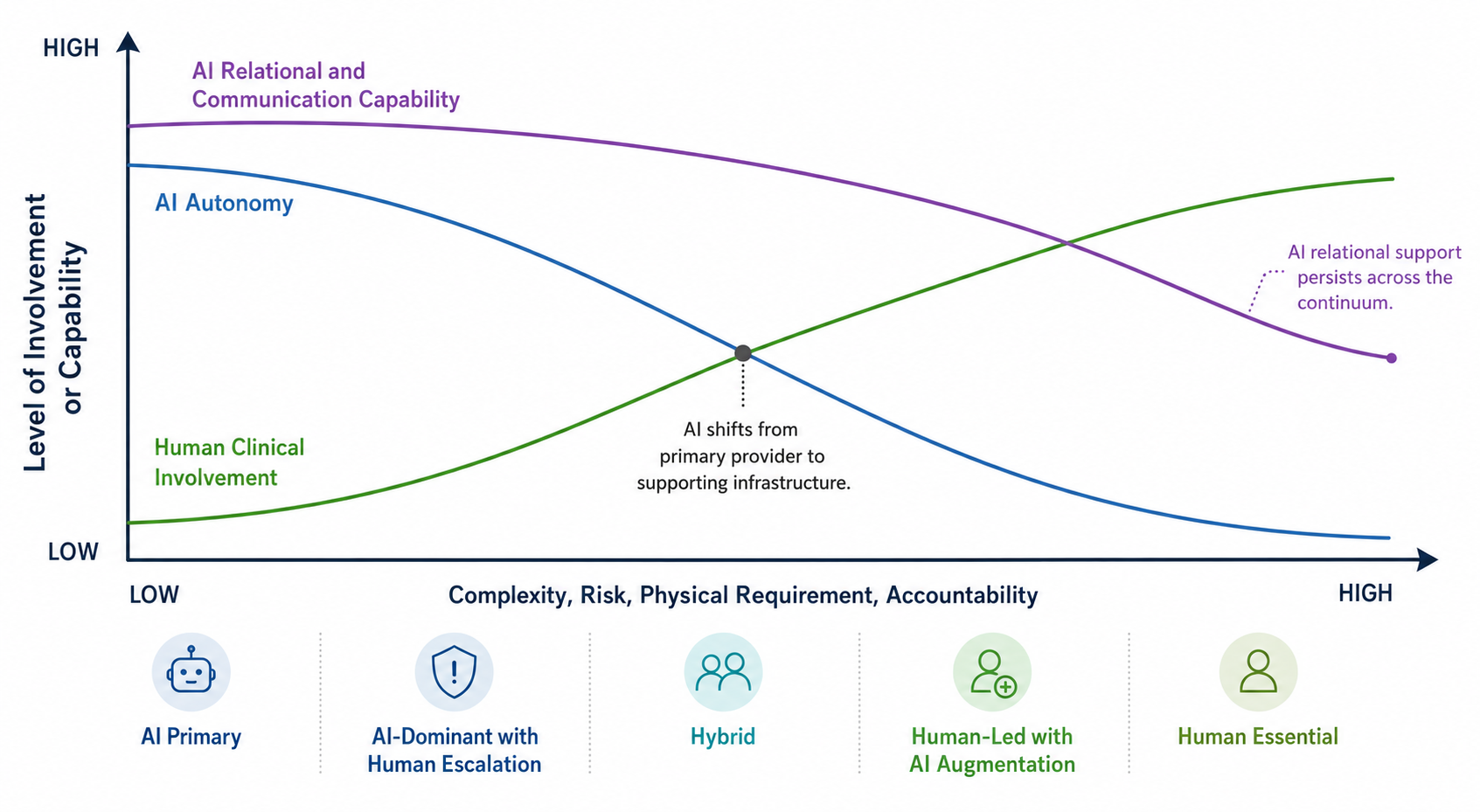
READING THE MODEL
The model proposes decreasing AI autonomy and increasing human clinical involvement as complexity, risk, physical requirements, and accountability rise. A third curve proposes that AI-supported communication may remain useful even when a clinician is needed for other aspects of care. That proposition should be assessed against the evidence and limitations discussed in the source paper.
The five zones, in the original order, are:
These descriptions interpret the source model’s zones for service-design discussion. They do not establish clinical eligibility rules.
1. AI Primary
AI carries out a bounded task with limited routine human involvement.
Accountability: People define the permitted scope, monitor performance, and remain responsible for the service and its escalation arrangements.
2. AI-Dominant with Human Escalation
AI handles the routine pathway and refers exceptions or uncertainty to a person.
Accountability: Escalation triggers, response times, and transfer of responsibility must be practical and explicit.
3. Hybrid
AI and people contribute complementary parts of the same process.
Accountability: Define who makes each decision and verify handovers so responsibility is not lost between systems and staff.
4. Human-Led with AI Augmentation
A clinician leads decisions while AI supports tasks such as drafting, measurement, or organization.
Accountability: The clinician reviews relevant outputs and can challenge or override them.
5. Human Essential
The task depends on human judgment, physical skill, relational presence, or direct accountability.
Accountability: A person delivers and owns the essential part of care; supporting technology may still have a role.
A WORKED EXAMPLE
Consider an assistant drafting routine appointment information. Staff approve the draft before it is sent: this fits human-led augmentation. Giving it permission to send approved templates within defined rules increases its autonomy and requires monitoring and an escalation route. Permission to change a person’s care plan would raise different consequences and require a separate assessment.
The same product can sit in different zones depending on the task and its permissions. This example illustrates service design; it does not validate any product or care pathway.
APPLYING THE PERSPECTIVE
The wider PhysioFuturist framework adds questions about permissions, uncertainty, reversibility, and effective oversight. A practical assessment should ask:
- What task and decisions would be delegated, and what would remain under human control?
- What evidence supports reliable performance in this setting?
- What consequences could follow, and can an error be detected and reversed?
- Who has the competence, time, and authority to intervene?
- How do the expected benefits and risks compare with the existing approach?
These questions guide examination of a proposed use. Decisions still require evidence appropriate to the setting, the needs of those affected, and the applicable professional obligations.